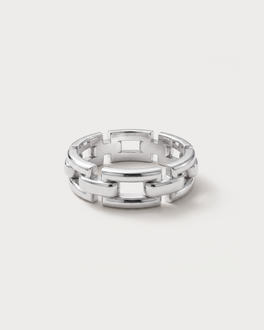
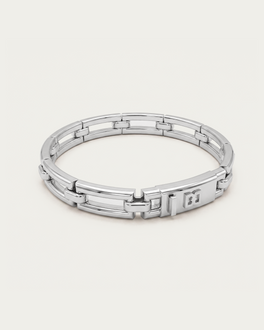
Sterling Silver vs Stainless Steel Rings: An Honest Comparison

Short answer. Stainless steel is the better ring if you want something cheap, scratch resistant and maintenance free that you might replace in a few years. Sterling silver is the better ring if you want real precious metal that can be resized, repaired and re polished for decades, and that darkens into character instead of wearing out. Steel is a tool. Silver is something you keep.
Both are good materials. They are good at different things, and most of the confusion comes from shops that blur the two together with words like "silver tone." Here is an honest side by side.
The quick comparison
| 925 sterling silver | 316L stainless steel | |
|---|---|---|
| What it is | 92.5% pure silver, 7.5% other metal (usually copper) | Iron alloy with chromium and nickel |
| Precious metal | Yes | No |
| Weight in the hand | Heavier. Density about 10.4 g per cm³ | Lighter. Density about 8.0 g per cm³ |
| Scratches | Scratches more easily, polishes back out | Resists scratches better, deep scratches are hard to remove |
| Tarnish | Darkens slowly, cleans off in seconds | Does not tarnish |
| Resizing | A jeweler can usually resize it | Very hard to resize, usually replaced |
| Repair | Can be soldered, refinished and re polished indefinitely | Limited, most jewelers won't work on it |
| Typical price | Higher, because the metal itself has value | Low, the metal is cheap |
| Lifespan | Generations if cared for | Years to decades, then replaced |
What you are actually buying
Sterling silver is a precious metal alloy. Pure silver is too soft for a ring you wear every day, so it is mixed with 7.5% copper to make it strong. That is where the 925 comes from. A solid sterling ring is silver all the way through, so every scratch, every polish and every repair is still silver underneath.
Stainless steel rings are almost always made from 316L, sometimes called surgical steel. It is an industrial alloy of iron, chromium and nickel, the same family of metal used in kitchen sinks and medical tools. It is tough and corrosion resistant, and the raw metal costs very little. That is why steel rings are usually priced in the tens of dollars.
Neither one is fake. The problem is when steel or brass is plated with a thin layer of silver colored metal and sold as "silver." If you are not sure what you have, our guide on how to tell if a silver ring is real walks through seven simple tests.
Durability, the honest version
This is where steel wins on paper. Stainless steel is much harder than sterling silver, so it picks up fewer fine scratches. If you work with your hands, lift weights or bang your ring against things all day, a steel ring will look newer for longer.
But hardness is not the same as lifespan. Two things matter more over ten or twenty years.
Silver can be brought back. Fine scratches on sterling polish out with a cloth. Deeper wear can be refinished by any jeweler, and a cracked or bent band can be soldered and reshaped. There is real metal to work with, so a silver ring can be restored again and again.
Steel mostly can't. When a steel ring gets a deep gouge, or bends, or no longer fits, most jewelers will not touch it. Their tools are made for gold and silver, and steel is hard on them. The usual fix is to buy a new ring.
So steel holds up better day to day, and silver holds up better across a lifetime. Which one matters more depends on what you want the ring to be.
Tarnish is not damage
Real silver reacts with sulfur in the air and on skin and slowly forms a thin dark layer called tarnish. Some people see that as a flaw. It isn't. It sits on the surface, it wipes off with a silver polishing cloth in about thirty seconds, and on textured pieces many men leave it in the grooves on purpose because it makes the pattern stand out.
Steel does not tarnish at all. If you never want to think about your ring, that is a real advantage. If you like the idea of a ring that shows how it has been worn, silver gives you that. Our care guide covers how to clean it and how to slow tarnish down.
Skin sensitivity
Nickel is one of the most common causes of contact allergy, and 316L stainless steel contains nickel. It is bound tightly in the alloy and releases very little, so most people wear steel with no trouble at all, but some very sensitive people do react.
Sterling silver is usually nickel free, since the standard alloy is silver and copper. The copper can occasionally leave a faint dark or green mark on some skin, which washes off and is harmless. If you have a known nickel allergy, check the alloy before you buy either metal.
Sizing and fit
Fingers change. Weight goes up and down, knuckles get bigger with age, and a ring that fit at 25 might not fit at 45.
A sterling silver band can usually be resized by a jeweler, typically by a size or so up or down depending on the design. Patterned bands like twisted or braided designs are trickier, because cutting and rejoining interrupts the pattern, which is why getting the size right at the start matters. Our size guide and the article on how to measure ring size at home help with that.
Stainless steel is very hard to resize, so in practice a steel ring that no longer fits gets replaced.
Weight and feel
Silver is denser than steel, roughly 10.4 grams per cubic centimeter against about 8.0 for stainless. Two rings of exactly the same size and shape, one in solid sterling and one in steel, will not feel the same. The silver one is noticeably heavier and sits differently on the hand.
That weight is also one of the easiest ways to spot a hollow or plated "silver" ring. A solid sterling piece should feel substantial for its size.
Price, and what it really pays for
A steel ring is cheap because the metal is cheap and it is usually machined or cast in large runs. A solid sterling ring costs more because the metal itself has value, and because silver is worked by hand far more often.
The fair way to compare them is cost per year. A $40 steel ring you replace every few years and a solid silver ring you wear for thirty years and then hand down are not really competing for the same job.
So which one should you buy?
Choose stainless steel if you want a low cost ring for the gym, a job site or travel, you never want to clean it, or you are still figuring out whether you like wearing a ring at all.
Choose sterling silver if you want a real precious metal piece, you want to be able to resize and repair it, you like a ring that develops character, or you are buying something meant to be kept and eventually passed on.
Plenty of men own both. A steel band for rough days, and one good silver ring for everything else.
How we make ours
Every Bucarti piece is solid 925 sterling silver, never plated, hallmarked and assay stamped. Each one is made to order by one silversmith in Lithuania and ships in 2 to 7 days, with free US shipping. If the size is wrong you get a free size exchange, and every piece comes with lifetime repair and re polish under our guarantee. Silver can be restored for as long as it exists, which is the whole reason we can offer that.
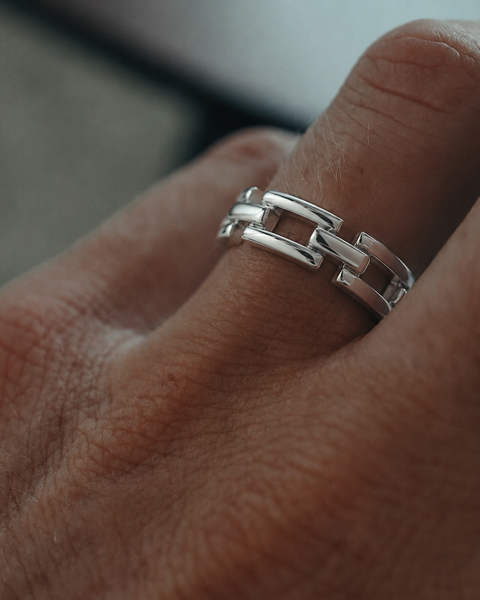
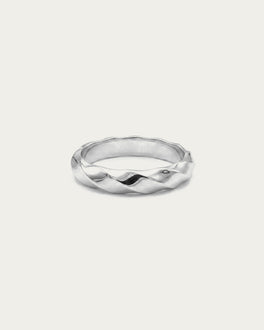
If you want to see what that looks like on the hand, start with the Twisted Ring, the Braided Ring or the Genesis Slim Ring, or browse all rings.
FAQ
Is stainless steel better than sterling silver for a ring?
It is better at resisting scratches and it never tarnishes. Sterling silver is better for resizing, repair, long term value and lifespan. Steel suits rough daily use, silver suits a ring you plan to keep for decades.
Will a sterling silver ring last as long as a stainless steel ring?
Longer, in most cases. Silver scratches more easily, but it can be polished, refinished, resized and repaired again and again. Steel resists wear well but is hard to repair, so it usually gets replaced once it is damaged or stops fitting.
Does stainless steel turn your finger green?
Good quality 316L stainless steel rarely does. Green marks usually come from copper or brass, including cheap plated rings. Sterling silver can occasionally leave a faint mark because of its copper content, which washes off.
Can you resize a stainless steel ring?
Rarely. Steel is very hard to cut and rejoin, and most jewelers won't do it. A sterling silver ring can usually be resized by a jeweler.
Is stainless steel jewelry cheap or low quality?
Not low quality, it is a tough and useful material. It is inexpensive because the metal itself has little value. You are paying for the design and the making, not the metal.
Can I wear a sterling silver ring every day?
Yes. Solid sterling is made for daily wear. Take it off for heavy lifting, chlorine pools and harsh cleaning chemicals, and give it a quick wipe with a polishing cloth when it darkens.